
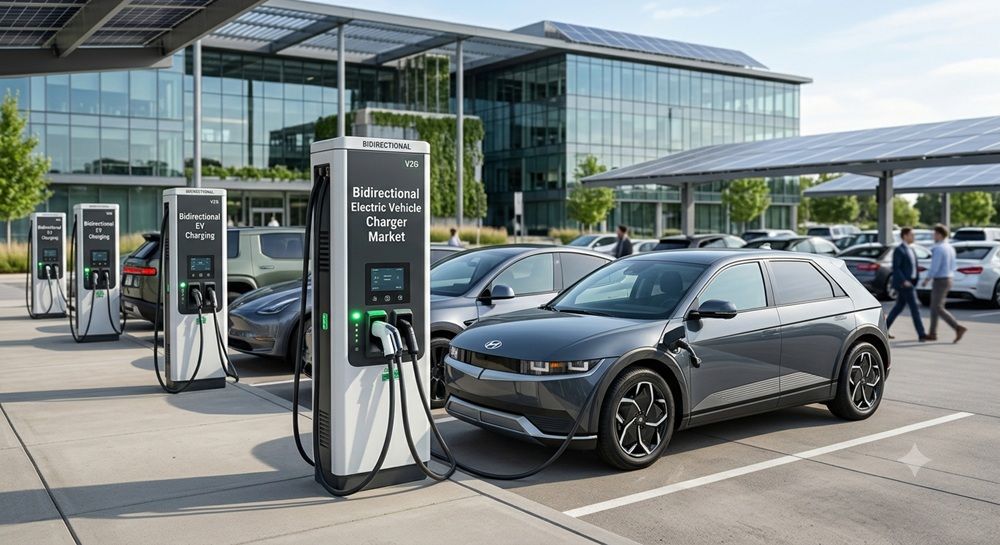
The bidirectional electric vehicle charger market is gaining momentum as electric vehicles evolve into flexible energy resources. Unlike conventional chargers, bidirectional systems enable electricity to flow from the grid to vehicle batteries and back to homes, buildings, or the grid. Growing electric vehicle adoption, renewable energy integration, and demand for reliable backup power are creating opportunities for manufacturers, automakers, utilities, and charging infrastructure providers.
What are the Key Drivers of the Market?
- Growing electric vehicle adoption: Increasing deployment of battery electric vehicles (BEVs) is expanding demand for advanced charging solutions that support two-way energy transfer.
- Renewable energy integration: Bidirectional chargers can store surplus solar and wind energy in compatible EV batteries and return electricity when generation is limited.
- Demand for energy cost savings: Vehicle owners can potentially reduce electricity expenses by charging during off-peak periods and using stored energy during peak-demand hours, subject to local tariffs and service availability.
- Grid stability and energy resilience: Utilities can use connected EVs to support load balancing and other grid services, while households may benefit from backup power during outages when compatible equipment is installed.
Which Applications are Supporting Market Growth?
Bidirectional charging supports several applications across residential, commercial, and energy infrastructure settings. Vehicle-to-grid (V2G) systems enable compatible EVs to supply electricity to the power grid, while vehicle-to-home (V2H) technology allows vehicles to power household appliances or essential systems. Vehicle-to-load (V2L) and vehicle-to-vehicle (V2V) capabilities extend energy sharing to external devices and other vehicles, depending on system compatibility.
Get A Sample for Bidirectional Electric Vehicle Charger Market - Focus on Application, Product, and Country-Level Analysis and Forecast, 2025-2034
What are the Key Trends Shaping the Market?
- Original equipment manufacturer integration: Automakers and charging equipment manufacturers are increasingly exploring factory-integrated solutions to improve compatibility and simplify deployment.
- Smart charging and energy management: Intelligent software can coordinate charging and discharging according to electricity prices, energy demand, battery status, and grid requirements.
- Expansion of residential charging: Homeowners are exploring bidirectional systems for backup electricity, energy management, and integration with rooftop solar installations.
- Advancements in charging technology: Improvements in power electronics, communication protocols, and energy management systems are supporting more efficient and reliable two-way charging solutions.
Which Regions are Influencing Market Development?
Europe, North America, and Asia-Pacific are important regions for the bidirectional electric vehicle charger market. Europe benefits from electric mobility initiatives and renewable energy integration efforts. North America presents opportunities through residential energy management, grid modernization, and emerging V2G programs. Asia-Pacific is supported by expanding EV manufacturing, rising electric mobility adoption, and investment in charging infrastructure, particularly in China and other developing EV markets.
What Challenges and Opportunities Lie Ahead?
High initial installation costs, limited interoperability, regulatory differences, and concerns about battery degradation can restrict adoption. Bidirectional charging also requires compatible vehicles, chargers, electrical systems, and communication standards, which can complicate implementation.
However, these challenges create opportunities for manufacturers to develop interoperable equipment, cost-effective residential solutions, and advanced energy management software. Partnerships among automakers, utilities, charging network operators, and renewable energy providers can accelerate commercialization. Businesses that address compatibility, installation costs, and consumer confidence will be better positioned to benefit from expanding demand for flexible energy systems.
Click Here to Download the ToC
Conclusion
The bidirectional electric vehicle charger market is positioned to benefit from the convergence of electric mobility, distributed energy storage, and smart grid development. Wider vehicle compatibility, clearer regulations, and improved charging economics will be important to mainstream adoption. As manufacturers and utilities expand commercial deployments, bidirectional charging could create new value for EV owners while supporting more flexible and resilient electricity systems.