
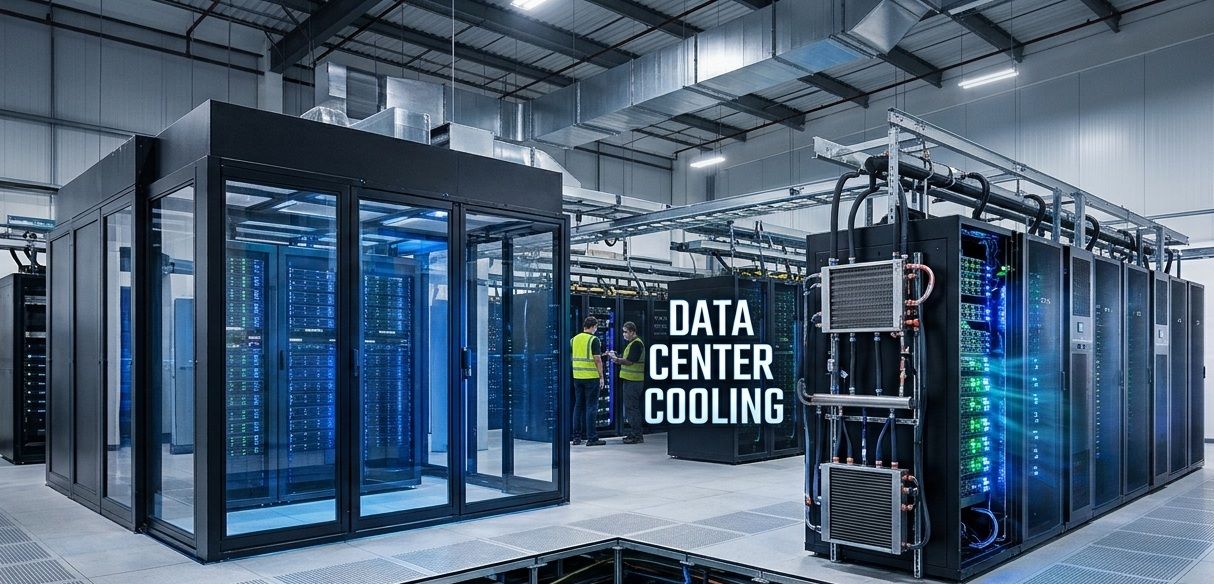
The data center cooling market is expanding as artificial intelligence (AI), high-performance computing, cloud services, and rising rack power densities increase thermal management requirements. According to BIS Research, the market is projected to grow from $18.35 billion in 2025 to $141.19 billion by 2036, at a CAGR of 17.02% during 2026–2036.
What are the Key Drivers of the Data Center Cooling Market?
- Growing AI and high-density computing: GPU-intensive workloads generate significant heat, increasing demand for advanced cooling technologies.
- Expansion of hyperscale and colocation facilities: Large-scale data center construction is driving investment in reliable and scalable thermal infrastructure.
- Increasing rack power densities: Conventional air-based systems are facing greater limitations as computing equipment becomes more powerful.
- Focus on energy efficiency and sustainability: Operators are adopting solutions that can reduce energy consumption, improve operational efficiency, and support environmental objectives.
Why are Centralized Data Centers Expected to Dominate the Market?
Centralized data centers are projected to maintain their leading position, representing approximately 77.8% of the global market in 2025. The segment is expected to grow from $14,271.4 million in 2025 to $111,233.8 million by 2036, supported by ongoing investments in hyperscale and colocation campuses that require reliable, large-scale cooling infrastructure. Although edge and decentralized facilities are growing with the expansion of distributed computing and localized AI workloads, centralized data centers are expected to retain the largest installed base and generate the strongest demand for cooling solutions.
Download the ToC for Data Center Cooling Market - Focus on Application, Product, and Region Analysis and Forecast, 2026-2036
What are the Key Trends Shaping the Market?
- Transition toward liquid cooling: Direct-to-chip cooling, immersion cooling, and rear-door heat exchangers are gaining attention for high-density workloads.
- Growth of hybrid cooling architectures: Operators are combining air and liquid cooling to support evolving infrastructure requirements.
- Intelligent thermal management: Sensors, software, monitoring platforms, and predictive controls are improving cooling optimization.
- Greater focus on retrofit-friendly solutions: Existing facilities are being upgraded to accommodate AI and high-performance computing infrastructure.
How is the Data Center Cooling Market Developing Across Regions?
North America is expected to remain a major market, supported by its extensive hyperscale and colocation infrastructure and continued investment in AI and cloud computing. Asia-Pacific also presents significant growth potential as countries such as China, Japan, South Korea, and India expand their digital and AI infrastructure. Meanwhile, European markets are increasingly emphasizing energy-efficient and sustainable cooling technologies.
What Challenges and Opportunities Exist in the Market?
Advanced cooling infrastructure can require substantial capital investment, particularly when retrofitting older facilities. Integration complexity, power availability, water constraints, and infrastructure limitations can also affect deployment decisions.
However, these challenges are creating opportunities for modular and retrofit-compatible technologies. The modernization of existing data centers, expansion of edge computing, and growing deployment of AI infrastructure are opening new opportunities for providers of liquid cooling systems, intelligent controls, monitoring platforms, and lifecycle services.
Who are the Key Players in the Data Center Cooling Market?
- Schneider Electric
- Vertiv
- STULZ GmbH
- Rittal GmbH & Co. KG
- Johnson Controls International plc
- Daikin Industries, Ltd.
- Trane Technologies plc
- Carrier Global Corporation
- Munters Group AB
- Airedale by Modine
- CoolIT Systems Inc.
- Submer Technologies
- ZutaCore, Inc.
- Alfa Laval AB
- Danfoss A/S
Get More Insights for Data Center Market
Conclusion
The data center cooling market is undergoing a significant transition as AI and high-density computing reshape thermal management requirements. While conventional cooling technologies will remain important, liquid and hybrid architectures are expected to gain greater adoption. Companies that deliver energy-efficient, scalable, intelligent, and retrofit-compatible solutions will be well positioned to address the evolving needs of hyperscale, colocation, enterprise, and edge data centers.