
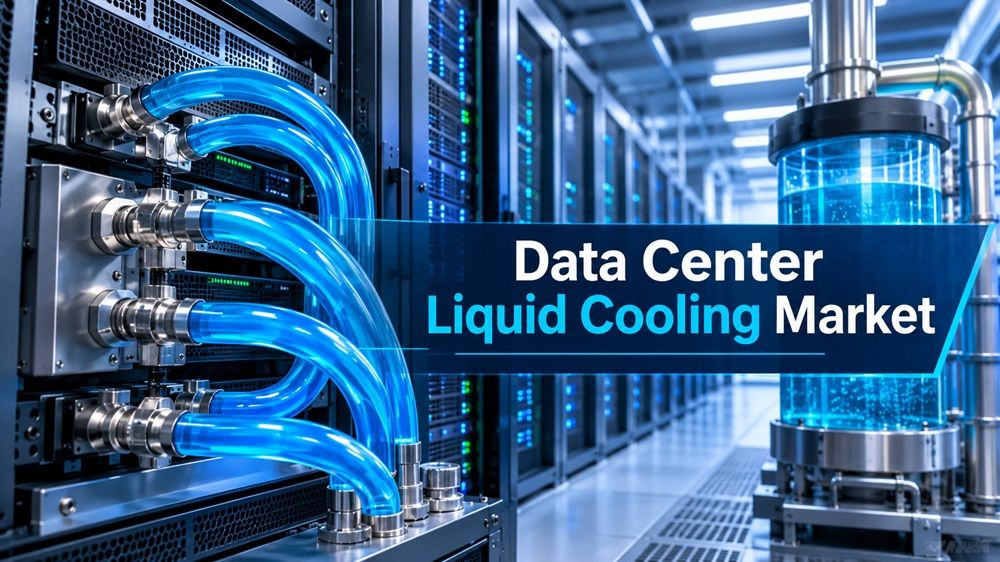
The Data Center Liquid Cooling Market is gaining momentum as rising computational workloads, artificial intelligence (AI), and cloud computing increase the demand for efficient thermal management. Traditional air-cooling systems face limitations in handling high-density server environments. Liquid cooling technologies offer improved heat dissipation, energy efficiency, and operational reliability, making them increasingly important for modern data center infrastructure.
According to BIS Research, the global data center liquid cooling market, valued at $5,654.8 million in 2024, is expected to reach $48,427.0 million by 2034, exhibiting a robust CAGR of 23.96% during the forecast period 2024-2034.
What are the Key Drivers of the Data Center Liquid Cooling Market?
- Growing AI and High-Performance Computing Workloads: Increasing adoption of AI, machine learning, and high-performance computing is generating substantial heat, driving demand for advanced cooling solutions.
- Expansion of Hyperscale Data Centers: Growing investments in large-scale cloud infrastructure are accelerating the adoption of liquid cooling systems to manage higher server densities and computational requirements.
- Increasing Focus on Energy Efficiency: Data center operators are prioritizing solutions that reduce cooling-related electricity consumption, operational expenses, and environmental impact.
- Rising Data Center Investments: Expanding digital services, 5G connectivity, and enterprise cloud adoption are encouraging investments in modern data center infrastructure and advanced cooling technologies.
How is the Data Center Infrastructure Supporting Market Growth?
Increasing rack power density and the deployment of advanced computing hardware are transforming data center infrastructure requirements. Liquid cooling solutions, including direct-to-chip systems, immersion cooling, and rear-door heat exchangers, help manage thermal loads more effectively. These technologies enable operators to improve server performance, optimize energy consumption, and support increasingly demanding computing environments.
Download ToC for Data Center Liquid Cooling Market - Focus on Product, Application, and Country Analysis and Forecast, 2024-2034
What are the Key Trends Shaping the Data Center Liquid Cooling Market?
- Growing Adoption of Immersion Cooling: Single-phase and two-phase immersion cooling technologies are gaining attention for their ability to manage high thermal loads in advanced computing environments.
- Increasing Deployment of Direct-to-Chip Cooling: Direct-to-chip systems are emerging as an effective approach to removing heat directly from processors and other high-performance components.
- Integration of Sustainable Cooling Technologies: Companies are exploring environmentally responsible cooling fluids, improved heat management systems, and solutions that support data center sustainability objectives.
- Expansion of Edge Computing Infrastructure: Growing demand for low-latency processing is encouraging the development of compact and efficient cooling solutions for distributed and edge data centers.
Which End-Use Industries Are Driving Market Demand?
The IT and telecommunications sector represents a major demand contributor due to its growing reliance on cloud computing, AI, and high-volume data processing. Other important end-use industries include banking, financial services and insurance (BFSI), healthcare, government, manufacturing, and retail. Their increasing dependence on digital infrastructure is creating demand for reliable and energy-efficient cooling technologies.
Which Regions are Leading the Data Center Liquid Cooling Market?
North America is expected to lead the market, supported by substantial data center investments, hyperscale infrastructure expansion, and increasing emphasis on energy efficiency. Europe is advancing through sustainability initiatives and investments in efficient computing infrastructure. Meanwhile, Asia-Pacific is emerging as an important growth region, driven by expanding cloud services, digitalization, and data center development in China, India, Japan, and South Korea.
What Challenges and Opportunities are Influencing Market Development?
High initial investment requirements, infrastructure compatibility issues, and specialized maintenance requirements remain significant challenges for liquid cooling adoption. The availability of alternative cooling technologies also influences purchasing decisions.
However, opportunities are emerging through the retrofitting of existing data centers, waste heat recovery, and the development of advanced cooling fluids. Growing AI workloads and hyperscale infrastructure investments are expected to create additional opportunities for technology providers and solution developers.
Get More Insights for Data Center Market
What is the Future Outlook for the Data Center Liquid Cooling Market?
The Data Center Liquid Cooling Market is expected to experience strong growth as AI, cloud computing, and high-performance computing increase cooling requirements. Rising investments in hyperscale data centers, energy-efficient technologies, and advanced thermal management solutions will create new opportunities. Continuous innovation in direct-to-chip and immersion cooling is expected to further support market expansion.