
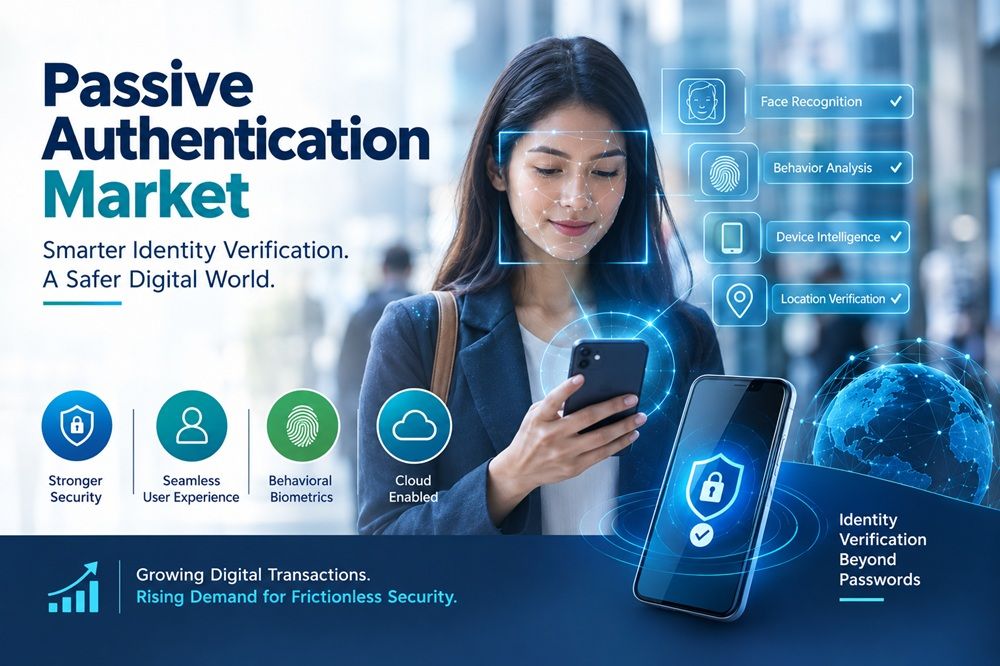
The passive authentication market is expanding as organizations seek stronger digital security without adding friction to user journeys. By analyzing behavioral patterns, device signals, and biometric indicators, these systems can help verify identity during online activity. According to BIS Research, the global passive authentication market was valued at $1.92 billion in 2024, is anticipated to grow at a CAGR of 21.26% and will reach $13.20 billion by 2034.
What are the Key Drivers of the Passive Authentication Market?
- Increasing cybersecurity threats: Rising incidents of identity theft, account takeovers, and digital fraud are encouraging organizations to adopt advanced identity verification technologies.
- Demand for frictionless authentication: Businesses are prioritizing security solutions that verify users without repeatedly requiring passwords or additional verification steps.
- Growth in digital transactions: Expanding online banking, e-commerce, and mobile services is increasing the need for continuous identity monitoring.
- Advancements in behavioral biometrics: Improvements in artificial intelligence (AI) and machine learning (ML) are enabling more effective analysis of user behavior and suspicious activity.
Which End Users are Adopting Passive Authentication Solutions?
End users include banks, insurers, government agencies, telecom and IT providers, retailers, healthcare organizations, and media companies. Financial institutions use passive authentication to detect suspicious account access and transactions, while healthcare providers can protect patient portals and sensitive records. Retailers and digital platforms apply these tools to reduce account takeover risk while keeping sign-in and checkout experiences convenient at scale.
Get A Sample for Passive Authentication Market - Focus on End-use Industry, Organization Size, Deployment Type, Component, Business Function, and Region Analysis and Forecast, 2024-2034
How Does Organization Size Influence Market Adoption?
Both small and medium-sized enterprises (SMEs) and large organizations represent demand opportunities. Large enterprises often have complex digital environments, high transaction volumes, and dedicated security teams, making continuous identity monitoring valuable. SMEs may adopt cloud-based services to access scalable protection without maintaining infrastructure. Adoption across both groups depends on implementation costs, integration requirements, privacy safeguards, and reductions in fraud and account compromise.
What are the Key Trends Shaping the Passive Authentication Market?
- AI-powered identity verification: Machine learning algorithms are improving behavioral analysis and helping identify deviations from established user patterns.
- Cloud-based deployment: Cloud solutions are enabling organizations to integrate authentication capabilities with existing digital platforms and scale operations more efficiently.
- Continuous authentication: Businesses are moving beyond one-time login checks toward ongoing verification throughout digital sessions and transactions.
- Integration with fraud prevention systems: Passive authentication is increasingly being incorporated into broader cybersecurity, risk management, and compliance workflows.
Which Regions are Driving the Passive Authentication Market?
North America remains an important market, supported by digital services, cybersecurity investment, and adoption across financial services and technology companies. Europe's demand is influenced by data protection requirements and security priorities. Asia-Pacific offers growth potential as digital payments, mobile services, and online commerce expand. Regional adoption will depend on regulatory frameworks, infrastructure, threat levels, and organizations' readiness to deploy behavioral analytics.
What Challenges and Opportunities Will Shape the Market?
The market faces challenges related to data privacy, regulatory compliance, implementation costs, and the accuracy of behavioral analysis. Changes in user behavior, shared devices, and evolving fraud techniques can also affect authentication reliability. Organizations must balance security requirements with transparent data practices and convenient user experiences.
However, opportunities are emerging through AI-driven fraud detection, cloud-based security platforms, and integration with existing identity management systems. Financial services, healthcare, retail, and government organizations can benefit from solutions that strengthen identity verification while reducing unnecessary interruptions. Vendors that prioritize interoperability, privacy protection, and accurate risk assessment will be better positioned to address evolving security requirements.
Click Here to Download the ToC
Conclusion
The passive authentication market is expected to benefit from increasing digital activity, growing cybersecurity concerns, and demand for seamless identity verification. Advances in AI, behavioral biometrics, and cloud deployment are creating opportunities across industries. However, long-term adoption will depend on addressing privacy concerns, improving detection accuracy, and managing integration costs. Continued innovation and enterprise investment are likely to support the technology's expanding role in digital security.