
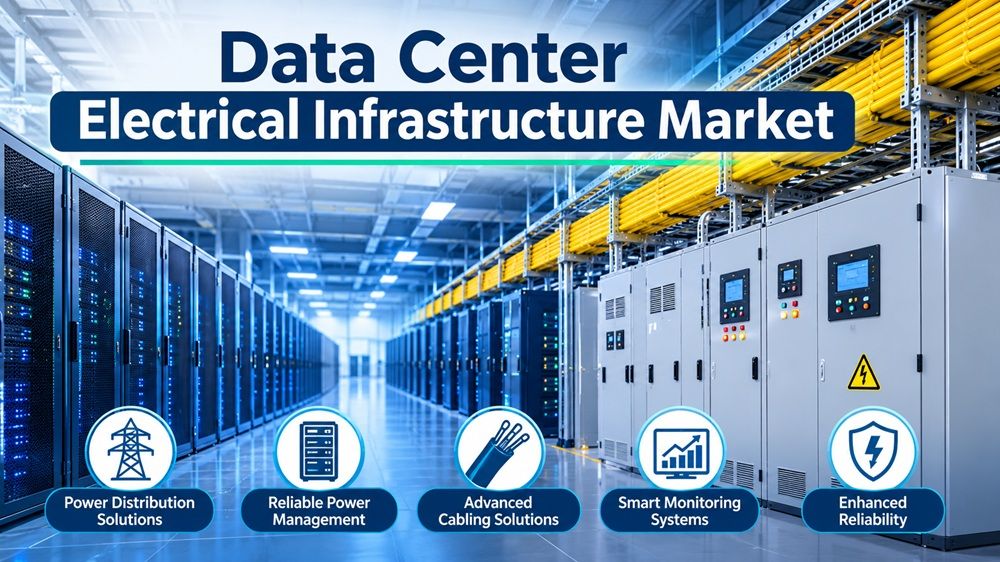
The U.S. and Canada data center electrical infrastructure market is expanding as artificial intelligence (AI), cloud computing, and high-performance computing (HPC) increase demand for reliable power distribution. According to BIS Research, the U.S. and Canada data center electrical infrastructure market is projected to reach $34,369.2 million by 2035 from $7,120.0 million in 2025, growing at a CAGR of 15.80% during 2026-2035.
What are the Key Drivers of the Market?
- Expansion of Data Center Capacity: New data center construction, campus expansion, and facility modernization are increasing demand for busways, power distribution units (PDUs), remote power panels (RPPs), and electrical cables.
- Growing Hyperscale and Colocation Investments: Significant investments by cloud service providers and colocation operators are creating sustained demand for electrical distribution equipment, supporting new installations and capacity upgrades.
- Increasing Rack Power Density: AI and HPC workloads require higher power capacity per rack, encouraging operators to upgrade electrical distribution systems and adopt more sophisticated power management solutions.
- Demand for Modular and Scalable Infrastructure: Data center developers are increasingly adopting standardized and prefabricated electrical systems to support phased construction, accelerate deployment, and accommodate changing power requirements.
Why is Colocation the Leading Application Segment?
Colocation emerged as the largest application segment in 2025, capturing 41.0% of the U.S. and Canada data center electrical infrastructure market. Its growth is driven by expanding capacity, robust preleasing activity, and increasing demand from hyperscale, cloud, AI, and enterprise customers seeking third-party data center facilities. Colocation providers are expanding campuses, developing new data halls, and upgrading electrical infrastructure to support higher rack densities and reliability requirements. These developments are generating consistent demand for busways, RPPs, PDUs, power cables, and monitoring systems. Additionally, multi-tenant facilities require flexible power distribution, tenant-specific energy monitoring, and scalable electrical architectures to accommodate diverse customer requirements.
Download ToC for U.S. and Canada Data Center Electrical Infrastructure Market - Focus on Market by Application, Product, and Country Analysis and Forecast, 2026-2035
What are the Key Trends Shaping the Market?
- Growing Adoption of Intelligent PDUs: Modern PDUs are evolving beyond basic power distribution to offer real-time monitoring, rack-level energy measurement, and improved load management.
- Increasing Use of Busway and Busduct Systems: Overhead power distribution architectures are gaining importance because they provide flexible and scalable electricity distribution across high-density data halls.
- Integration of Advanced Power Monitoring: Operators are investing in intelligent metering, branch-circuit monitoring, and integration with data center infrastructure management (DCIM) and electrical power monitoring systems (EPMS).
- Shift Toward Modular and Alternative Power Solutions: Prefabricated electrical rooms, modular power skids, battery storage, and alternative on-site power arrangements are gaining attention as operators address grid constraints and project delivery requirements.
What is the Country-Wise Market Outlook?
The U.S. dominates the regional market, supported by its extensive data center footprint, hyperscaler investments, and expanding colocation capacity. Canada is emerging as a growth market as cloud infrastructure, sovereign AI initiatives, and high-density computing projects attract investment. However, grid capacity, equipment availability, and project execution timelines will influence the pace of infrastructure deployment across both countries.
What Challenges and Opportunities Will Shape Market Growth?
Despite strong growth prospects, the market faces challenges associated with electricity grid constraints, lengthy interconnection timelines, equipment supply-chain limitations, and fluctuating copper and aluminum prices. Retrofitting existing facilities for higher-density computing also requires substantial engineering investment and careful coordination between electrical distribution and cooling systems.
However, these challenges are creating opportunities for manufacturers and technology providers. Growing demand for intelligent PDUs, advanced metering, modular electrical systems, and prefabricated power infrastructure is opening new revenue opportunities. The transition toward 800-VDC distribution and megawatt-scale rack architectures could further accelerate innovation. Additionally, domestic manufacturing expansion in the U.S. and government-supported sovereign AI infrastructure in Canada are expected to support long-term industry development.
Get More Insights for Data Center Market
Conclusion
The U.S. and Canada data center electrical infrastructure market is positioned for substantial growth through 2035, driven by AI adoption, cloud expansion, and increasing computing power requirements. Rising rack densities will accelerate demand for intelligent PDUs, modular busways, and advanced monitoring solutions. Companies investing in scalable technologies, manufacturing capabilities, and integrated power distribution systems will be well positioned to capitalize on emerging opportunities.